More than a Football Club: What the Tasmania Devils Teach Us About Place, Belonging and Economic Development
What happens when you build a football club not just to win games, but to represent an entire state, strengthen communities and create economic opportunity?
At the Economic Development Australia (EDA) National Conference in Hobart, one of the most compelling presentations came from Kath McCann of the Tasmania Football Club, home of the Tasmania Devils.
It wasn’t really a presentation about football. It was about place, identity, leadership, community ownership and the extraordinary economic potential that can be unlocked when people feel they belong to something bigger than themselves.
And for those of us working in economic development, tourism and place-based investment, there were some powerful lessons.
The oldest new club in Australia
Tasmania has been playing Australian rules football since 1866. Yet it has taken more than three decades of campaigning to secure its own AFL licence.
The Devils are technically a new club, but their story is more than 160 years old.
That distinction matters.
Unlike expansion clubs established to grow the AFL into new markets, the Devils are building on generations of existing passion, heritage and identity. Their challenge is to honour that history while creating a contemporary organisation capable of competing on the national stage.
Their purpose captures it beautifully: “To honour the map and inspire the future.”
The map isn’t simply a symbol on a football jumper. It represents the entire state, its people, communities and shared identity.
From the outset, the club’s leadership recognised that they weren’t simply building a sporting organisation. They were custodians of something Tasmanians already felt belonged to them.
Start with community, not the marketing campaign
One of the strongest messages from Kath’s presentation was the importance of showing up.
Before launching the club, its leadership travelled across Tasmania on what became known as the Lap of the Map, visiting communities, listening to local stories and understanding what the club needed to represent.
Importantly, they didn’t just visit the major population centres. They went to smaller, more remote communities where being included can make an enormous difference.
When the club launched in March 2024, it did so simultaneously across seven locations, with 150 community volunteers entrusted with the details before the public announcement.
No confidentiality agreements. Just trust.
The result was extraordinary.
Within 24 hours, the club had attracted 100,000 founding members. Within a month, that figure had grown to 216,000, against an initial forecast of 40,000 over six months.
The club had built a movement before it had fielded a team.
The economic development lesson? Community engagement isn’t something you do to secure support for a project. Done properly, it becomes the foundation of the project itself.
Belonging is an economic development asset
We often measure economic development through investment, jobs, business growth and infrastructure.
All important. But how often do we measure belonging?
The Devils are demonstrating how a shared identity can generate participation, volunteerism, community pride and new opportunities.
Kath described a 70% increase in football participation across Tasmania since the club’s launch, with participation targets being reached ahead of schedule.
That growth reaches beyond players. It creates demand for coaches, volunteers, local sporting facilities, suppliers and community services.
And it gives people across Tasmania a reason to connect.
For economic developers, this is a reminder that social outcomes and economic outcomes are not separate conversations.
A community that feels connected, represented and invested in its future is better positioned to participate in that future.
Make the big investment work for the whole place
The scale of the Devils’ economic contribution is significant.
Kath outlined a future organisation with projected annual turnover of $55 million to $60 million and an expectation of becoming one of Tasmania’s largest payroll tax contributors.
But the most interesting aspect wasn’t the size of the organisation. It was how deliberately the club is designing its impact beyond football.
Rather than concentrating all activities in Hobart, the Devils are adopting a decentralised approach, taking games, training camps and engagement activities to communities including Penguin and Queenstown.
They are also investing in local workforce development.
Through the Tasmanian Academy of Leadership and Sport, young Tasmanians can pursue education and career pathways that previously may have required leaving the state.
Importantly, the club has partnered with other sporting organisations, including the JackJumpers, Cricket Tasmania and Netball Tasmania, recognising that the benefits of building a stronger sporting workforce should extend beyond one organisation.
This is what effective place-based economic development looks like: using a major investment as a platform to build capability, retain talent and generate opportunities across an entire ecosystem.
Authenticity requires making different decisions
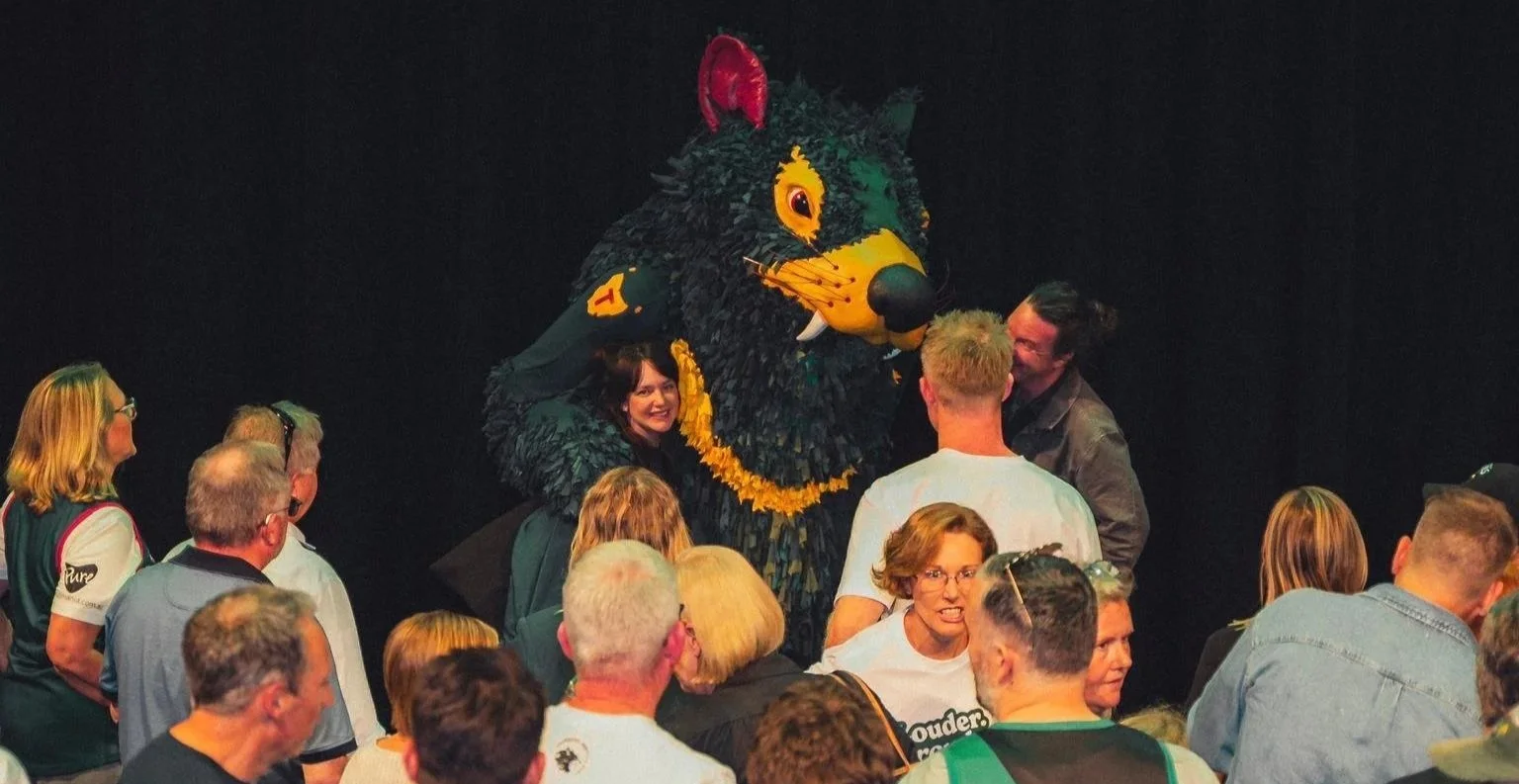
One of my favourite examples was the creation of Rum’un, the Devils’ mascot.
Rather than purchasing a generic mascot, the club partnered with Tasmanian puppetry company Terrapin and involved schoolchildren in its creation, incorporating recycled school uniforms donated by children across the state.
It would have been easier to take the conventional route.
But the result was something distinctly Tasmanian, created by local people, supporting local creative capability and giving children a personal connection to their club.
The same thinking is evident in the club’s approach to gender equity, including establishing men’s and women’s teams within the same foundation period and creating opportunities to challenge longstanding sporting conventions.
These decisions aren’t incidental branding exercises. They are practical expressions of the organisation’s purpose.
The bigger lesson for economic development
Too often, we begin major projects by asking what infrastructure we need, how much investment we can attract or how many jobs we can create.
The Devils offer a different starting point.
Who is this for? Who gets to participate? What makes this place distinctive? And how can the benefits reach further than the organisation itself?
Of course, not every community has an AFL licence or a major sporting investment to build around.
But every community has an identity, stories, local capabilities and people who want to see their place succeed.
The opportunity for economic development practitioners is to identify those assets and create platforms that connect them to investment, enterprise, participation and opportunity.
The Tasmania Devils haven’t played their first AFL premiership match yet, but they are already demonstrating something important.
The most powerful place-based investments don’t simply create something new. They give people a reason to believe in, participate in and shape the future of the place they call home.
And that may be the most valuable economic development outcome of all.