
You had to be there to get it.
There’s a big difference between visiting a region, and spending enough time there to actually understand and appreciate it.
At Sparrowly Group, we’ve never wanted to be fly-in, fly-out consultants. For us, developing genuinely place-based strategies means being present in the places we’re working with, spending time with the people who live and work there, supporting local businesses and seeing firsthand how decisions might impact on the ground.
Because an action that sounds good in a report can feel very different when you’re standing beside the business owner, resident or community organisation who could be impacted by it.
Recently, we spent a week immersed in a regional community as part of a project. We stayed locally, travelled throughout the region, bought from local businesses, met people where they were and spent time listening outside the confines of formal consultation sessions.
A comment we heard repeatedly was how much people appreciated that we’d actually come out, stayed in the region, shopped locally and taken a genuine interest in what was happening.
That matters.
Not because simply being physically present makes one a better consultant, but because presence creates context.
You begin to understand the distances people travel, the businesses that rely on one another, the places people gather, the availability of resources, the infrastructure constraints that don’t always appear in a desktop review and the very real consequences that strategic decisions can have for locals.
You also hear things differently.
A conversation in a meeting room might tell you what the formal issue is. A conversation over coffee, in a business, on a property, in a pub or while driving between towns can help explain why that issue exists in the first place.
Engagement has taken me to many corners of Australia, into remote and regional towns, to thriving hubs and capital cities. Some things that have remained with me amongst those visits:
Sometimes not reacting is the best response to allow for people to have their say and get whatever they may need off their chest.
The quietest in the rooms often have the most important things to say - provide the space and time for them to share and build trust.
The most useful insight isn’t always shared in the formal session. It’s often the conversation afterwards, in the car park or while walking out that gives you the context you were missing.
I’m not expected to walk into every room with all the answers, and I don’t need to prove that I’m the expert on someone else's place. Often the better approach is to be curious, ask the obvious or uncomfortable questions, listen properly and be willing to change my thinking based on what I learn.
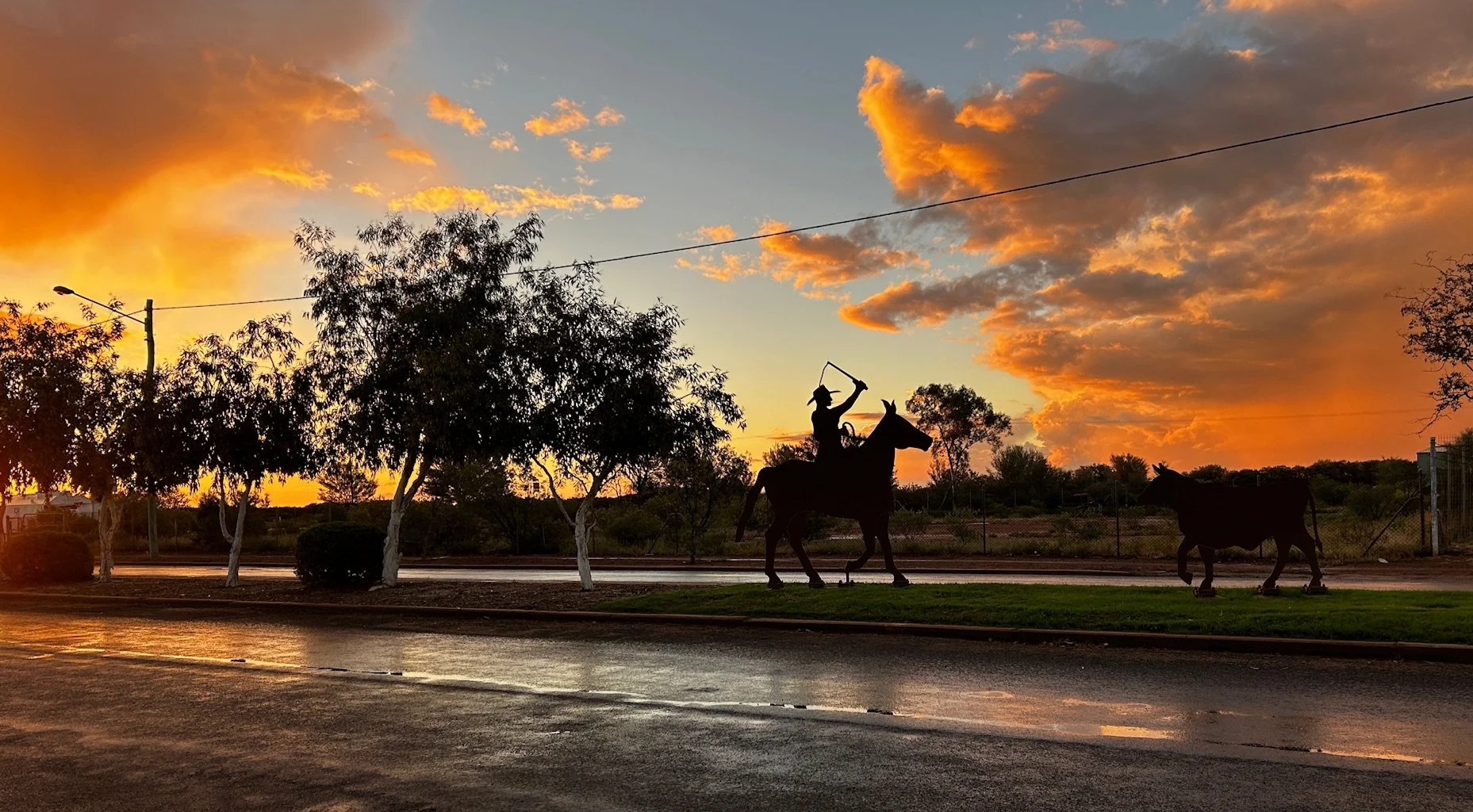
Sunset in Quilpie, QLD
We don’t arrive assuming we know the answer
Our backgrounds, experiences and professional expertise are important to us at Sparrowly Group. They shape how we approach problems and give us frameworks, knowledge and experience to draw upon.
But this expertise should never become a certainty.
Regardless of age, tenure or skillset, we don’t believe consulting should begin with a preconceived idea of what the answer is.
Every situation is different. Every place we work in is different. Every organisation is different. Every community carries its own history, relationships, ambitions, constraints and sensitivities.
What worked somewhere else may provide a useful reference point, but it cannot simply be transplanted into another place and be expected to work.
Our role isn’t to arrive and prove that our original thinking was right.
It’s to understand the problem properly enough that the right response can emerge.
Sometimes that means changing our view completely.
Place-based work requires participation
There is another important part of regional immersion that can sometimes be overlooked.
When you’re working in a community, even temporarily, you’re participating in its economy.
Where you stay matters.
Where you eat matters.
Where you buy fuel, coffee or supplies matters.
Taking the time to walk down the main street, visit local businesses, speak to locals and experience the region as other visitors might matters deeply.
It gives us better insight, but it’s also part of showing respect for the communities that are giving us their time, knowledge and trust.
For us, being seen is not about visibility for its own sake.
It’s about demonstrating that we’re prepared to make the effort to understand a place before suggesting what should happen next.
That will not mean we always get everything right.
In fact, one of the most important parts of our approach is accepting that we won’t.
But, if we remain curious, adaptive and willing to listen, challenge our own assumptions and spend meaningful time in the places we are working with, we have a much better chance of developing strategies and ideas that belong to the region rather than simply being delivered to it.